Specify padel court lighting by average illuminance, uniformity, and glare control. For UK regional and recreational use, SAPCA’s September 2025 guidance gives 300 lux average with 0.5 uniformity; competition and other markets need their own confirmed specification.
The brightest-looking quotation can still leave players struggling to follow a lob. A wattage label tells you electrical input. It doesn’t show the darkest corner, a reflection in the glass, or what players see when they look up.
When you’re buying courts, you need a proposal you can compare and an installation you can test. That means agreeing on the playing standard before choosing fixtures, then checking the layout, operating costs, and handover measurements. It’s easier to resolve those questions on a drawing than after columns and cables are installed.
This guide explains the differences between published lux references, what a lighting report should contain, and how to calculate electricity costs. It also gives you a practical specification and acceptance checklist. Start with your intended play and venue conditions, then use the results to compare suppliers on the same basis.
Key Takeaways
- SAPCA’s 2025 UK guidance specifies 300 lux average and 0.5 uniformity for regional and recreational use.
- The retrieved 2025 FIP Tour rulebook distinguishes indoor and outdoor competition targets; confirm the current event requirements before ordering.
- A 500 lux average with a 200 lux minimum produces 0.40 uniformity, below a specified 0.70 target.
- An illustrative 1.6 kW system uses 2,880 kWh over 1,800 full-output hours, costing USD 576 at USD 0.20/kWh.
- Agree on the calculation grid, maintenance assumptions, glare assessment, and completion tests before accepting a lighting package.
Padel court lighting requirements: which lux target applies?
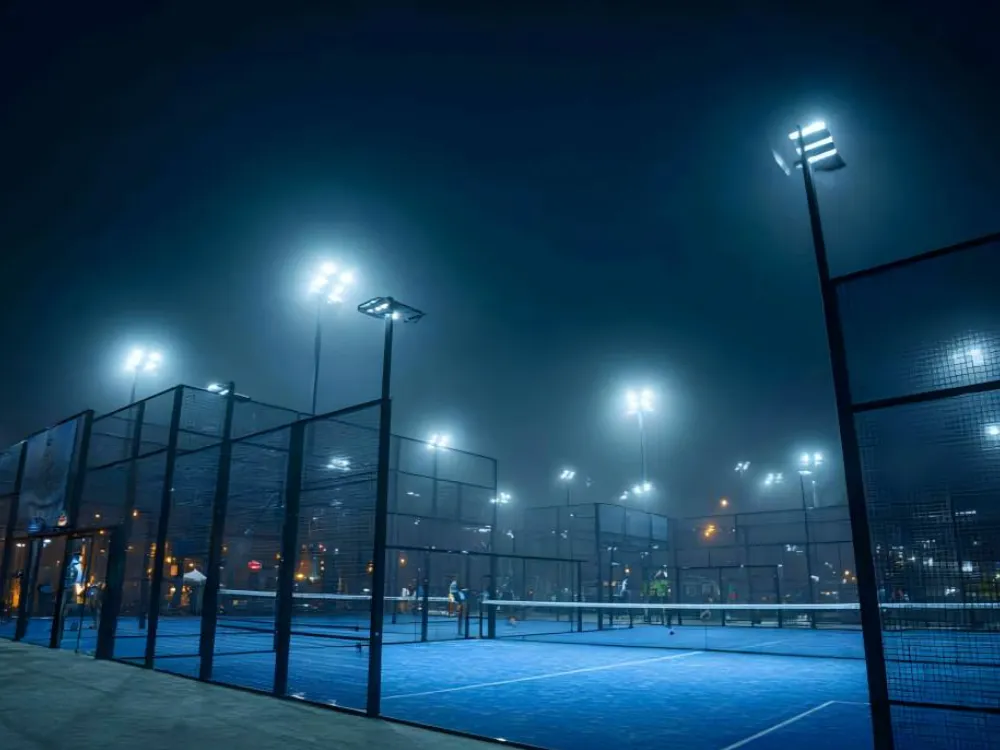
Lux measures light arriving at a surface. A horizontal reading measures light on a horizontal plane, such as the court surface. A vertical reading measures light on a vertical plane and matters when assessing camera-facing illumination.
Before comparing padel court lighting requirements, identify the source, intended use, indoor or outdoor setting, and measurement plane. “Competition lighting” alone leaves too much open.
For a UK project, SAPCA’s September 2025 code of practice, section 3.3, gives these horizontal ground-level references:
| Use described by SAPCA | Average illuminance | Uniformity |
|---|---|---|
| Regional competition, school and recreational use, indoor courts | 300 lux | 0.5 |
| National and international competition | 500 lux | 0.7 |
Still deciding on the venue format? Compare indoor and outdoor court planning before fixing the support arrangement.
Why FIP figures can differ
The International Padel Federation (FIP) uses a separate table in its March 2025 CUPRA FIP Tour Rulebook, section 11.1.7:
| Use in that rulebook | Outdoor horizontal average | Indoor horizontal average | Minimum / average uniformity |
|---|---|---|---|
| Local competition, training, school and recreation | 200 lux | 300 lux | 0.5 |
| National and international competition | 500 lux | 750 lux | 0.7 |
These are the retrieved 2025 rulebook’s values. Confirm the current requirements with the event organizer and project designer. Don’t combine the lower values from different documents into a supposedly universal padel court lighting standard.
Read the minimum as well as the average
Uniformity, expressed as minimum illuminance divided by average illuminance, shows how evenly light reaches the calculation grid. A ratio closer to 1 means a more even result. Check the formula because another report may express the reciprocal, average divided by minimum.
Hypothetical example: Alex compares two padel court lighting proposals for a new club. One claims 500 lux on average, but its darkest grid point is 200 lux. Dividing 200 by 500 gives 0.40, below Alex’s agreed 0.70 target. The layout or lights need to change before Alex accepts the work.
Also distinguish initial output from maintained performance. SAPCA references a 0.9 maintenance factor. For a maintained 300 lux target, dividing 300 by 0.9 gives about 333 lux initially. Ask the designer to explain the allowance for light loss and the cleaning schedule behind it.
Padel court lighting design: placement and glare
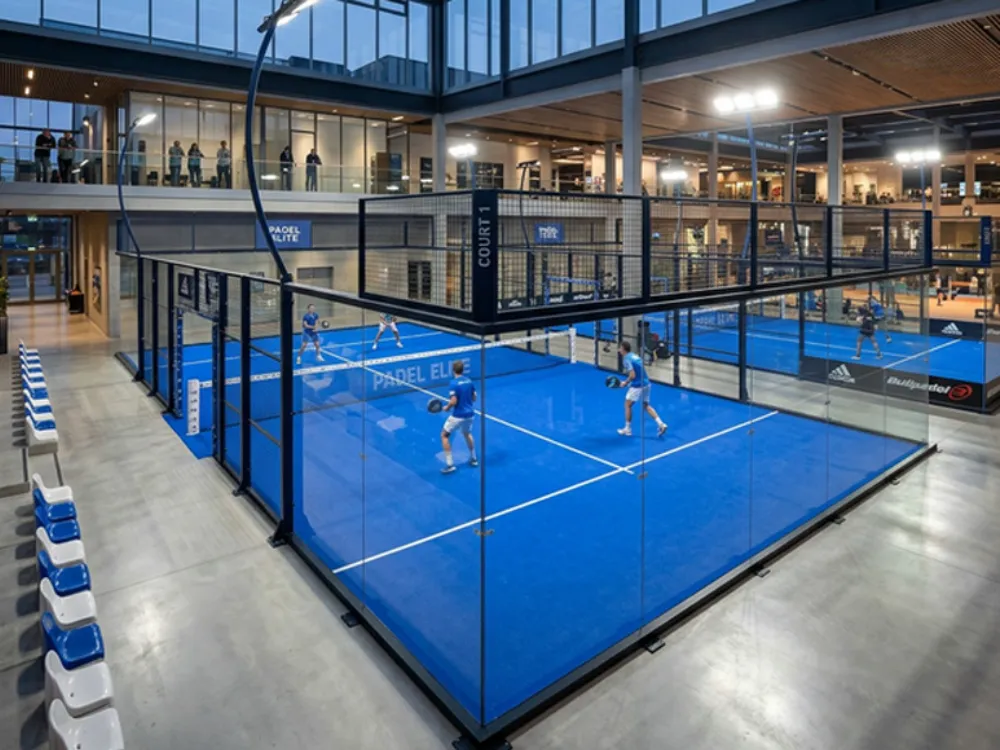
A useful padel court lighting design checks what players see through a full rally. Check overhead shots, back corners, glass rebounds, and moves toward the net. A bright centre court can still leave dark spots elsewhere.
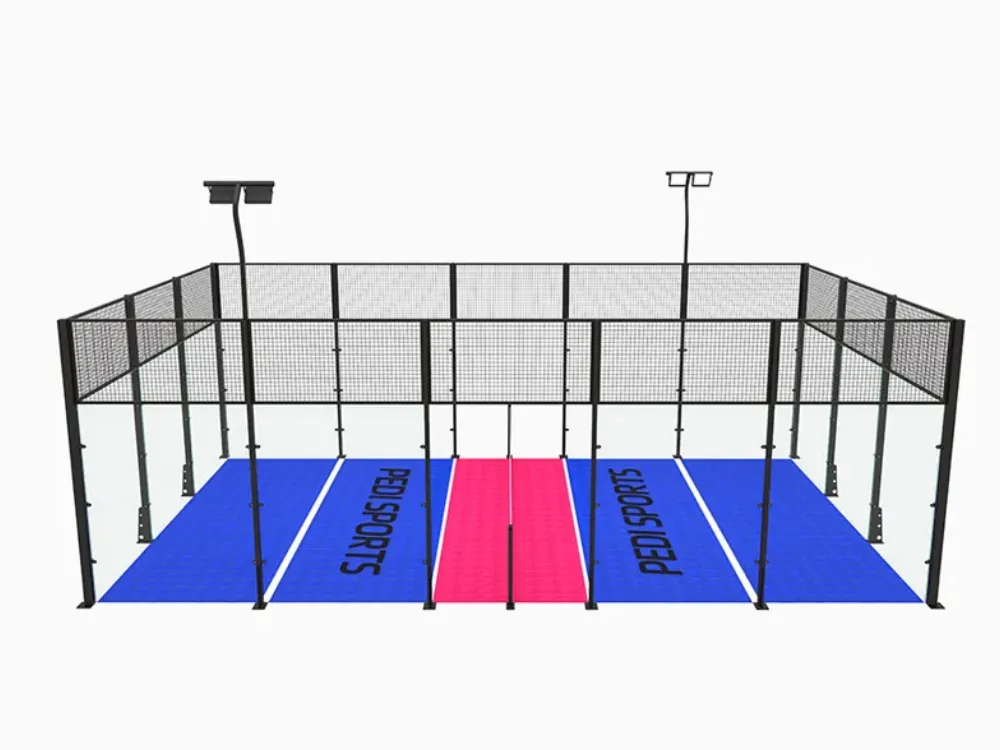
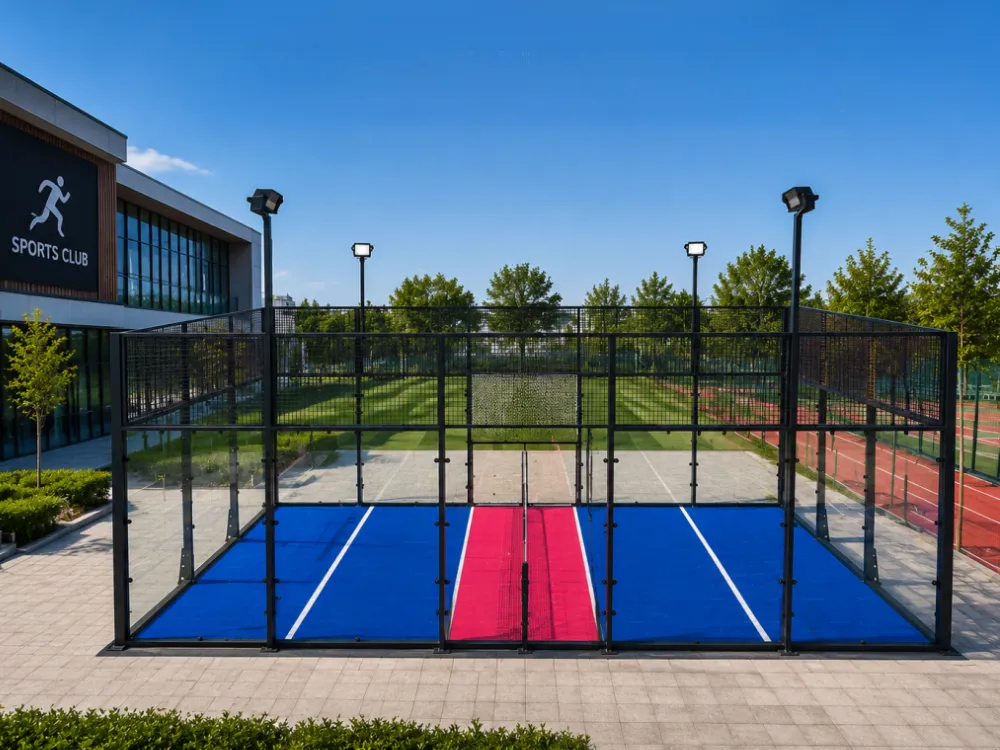
SAPCA describes three ways to support the lights: extended court posts, separate columns, and suitable roof frames. Its side-lighting layouts place supports or fittings 4 m in from the back walls. Discuss these layouts with your designer. The right choice depends on your site.
Preserve the playing volume
SAPCA calls for fittings to preserve a clear height of 6 m above the playing area. Clear space and pole height are different measurements. A bracket or fixture can project below the support height, and a building’s ceiling height doesn’t prove its playing volume is unobstructed.
For covered courts, coordinate the lighting with roof trusses and other overhead services. For separate columns, check access routes, foundations, and maintenance equipment. The support design must account for the actual fixture arrangement and local loads.
Four poles or eight fixtures can describe a package, but neither proves a padel court lighting result. The optic, mounting height, aiming angle, and distance from the playing area all affect where light lands.
Control glare and spill together
Ask the designer to check glare during lobs and light reflected by the glass. Asymmetric optics send light more strongly in some directions than others. These optics and shields can help, but the way you mount and aim them matters. Ask what design checks support an “anti-glare” claim.
Check nearby courts too. If the layout relies on light from the next court, what happens when that court shuts down? Test each switching and dimming mode you plan to use.
For UK projects, the ILP’s 2026 guidance on avoiding obtrusive light covers effects on surrounding properties and the environment. Agree on relevant windows, site boundaries, environmental zones, and operating hours with the appropriate specialists. Other countries and local authorities have their own requirements.
How to compare LED fixtures and controls
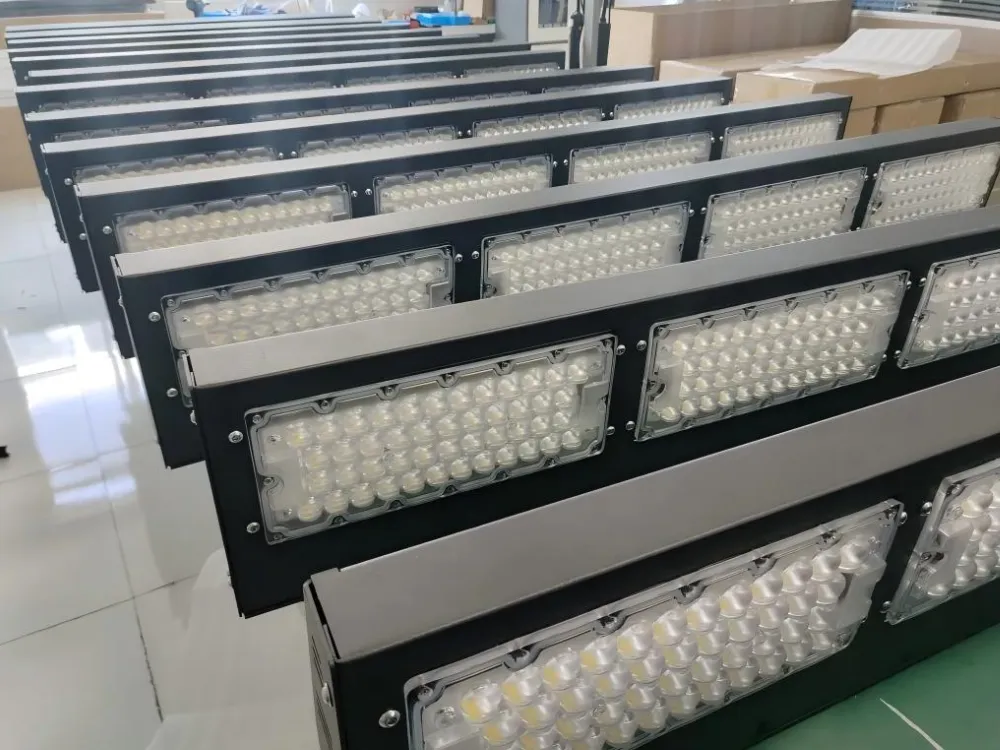
Compare padel court LED lighting using the exact model and optic in the quote. A general floodlight brochure can’t show how those lights will work on your court.
Ask for the photometric file, supplied in a format such as IES or LDT. This file shows how a fixture spreads its light. The designer uses it to work out light levels across your court. If the supplier changes the model or optic, ask for a new design report.
| Item to confirm | What it helps you assess |
|---|---|
| Full model code and optic | Whether the calculation matches the supplied equipment |
| Input power and supply voltage | Electrical load, compatibility, and running costs |
| Driver and dimming method | Control compatibility and behaviour at reduced output |
| Ingress and impact protection ratings | Suitability for the installation environment |
| Ambient-temperature limits and corrosion protection | Suitability for heat, moisture, and coastal exposure |
| Colour temperature and colour rendering | Agreed appearance and ball visibility |
| Replacement components and warranty terms | Service access, exclusions, and repair responsibility |
For padel court lighting, a high lumen output doesn’t prove the court will be well lit. Light can miss the playing area or create bright patches. Compare the light levels the design will maintain, as well as how much power the fixtures use.
Make controls part of the specification
Define the lighting modes your staff will use: booking, cleaning, training, and any approved competition setting. Agree on timers, manual overrides, and what happens after a control fault. Have each required play mode checked against its own performance target.
If filming is planned, tell the designer about the cameras and recording settings. Flicker behaviour and vertical illumination need attention; a fixture that looks steady to a player may behave differently on camera.
Finally, check how someone will clean the fittings and replace a driver. A lower equipment price can conceal difficult access. Include lighting access in your court maintenance planning before finalizing the roof or support details.
Padel court lighting cost: installation and electricity
Separate the equipment price from the installed padel court lighting cost. Compare quotations with the same drawings, performance target, currency, tax basis, and responsibilities.
An installation budget should identify fittings, brackets or columns, foundations, ducts, cable runs, electrical distribution and protection, controls, installation labour, design, and commissioning. Freight, taxes, access equipment, and future servicing may sit outside the headline figure.
For the wider investment, use the total court construction budget to check where lighting meets civil works and site preparation. Confirm current project prices in writing.
Calculate electricity from input power
The basic calculation is:
Energy in kWh = total input power in kW × operating hours.
Electricity cost = energy in kWh × tariff per kWh.
Here’s an illustrative padel court lighting calculation, using assumed values rather than a PEDI product specification:
| Assumption or result | Calculation | Value |
|---|---|---|
| Eight fixtures, each drawing 200 W | 8 × 200 W | 1.6 kW total |
| Six full-output hours on 300 nights | 6 × 300 | 1,800 hours/year |
| Annual electricity use | 1.6 × 1,800 | 2,880 kWh |
| Assumed energy tariff | USD per kWh | USD 0.20 |
| Annual energy charge | 2,880 × 0.20 | USD 576 |
| Energy charge per operating hour | 1.6 × 0.20 | USD 0.32 |
This excludes fixed charges, demand charges, taxes, maintenance, and other electrical circuits. Replace the assumptions with your quoted input power, local tariff, and actual schedule.
Hypothetical example: Morgan plans a court using those eight 200 W fixtures. They plan to open for six hours on 300 nights each year. That’s 1,800 hours of use and a USD 576 energy cost at the assumed rate. Morgan can now compare a second quote using the same hours and rate.
This gives Morgan a clear budget for power use. It doesn’t prove either set of lights meets the required lux and uniformity targets.
If dimming is offered, calculate each mode using documented input power and hours. Don’t assume that a 50% control setting always draws exactly half the electricity. For retrofit savings, compare old and new measured loads at equivalent useful performance, then include installation and maintenance costs.
Specify and test the finished installation
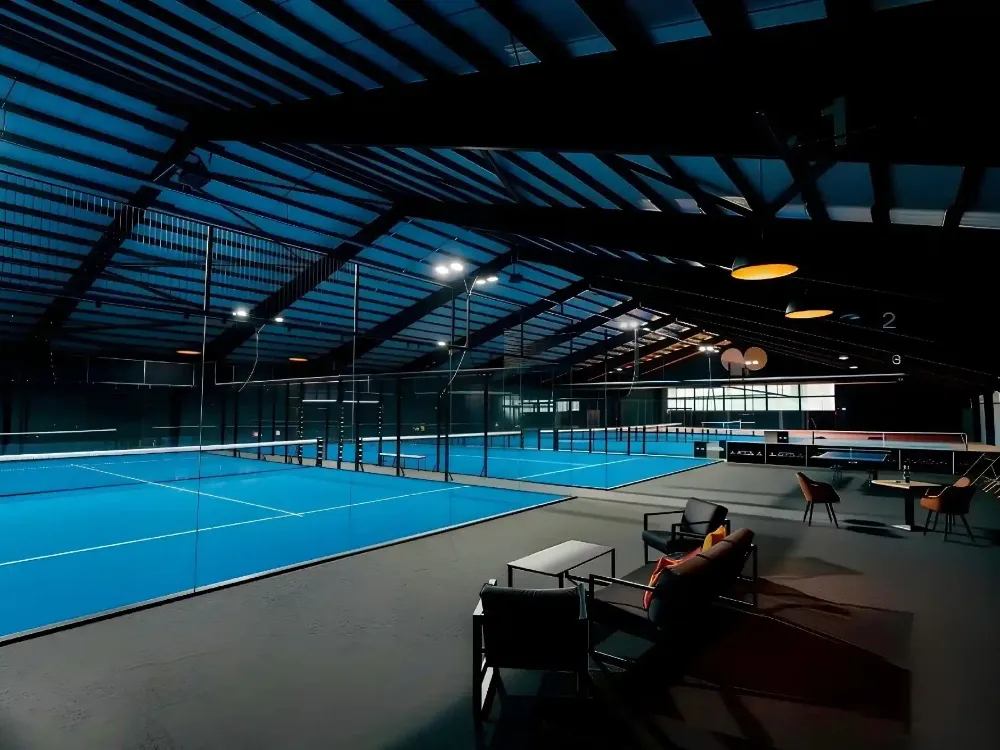
Agree on padel court lighting acceptance criteria before ordering. The calculation report should identify the exact equipment, installation geometry, and performance assumptions, so the finished work can be compared with the proposal.
Use this checklist when reviewing a lighting package:
- Purpose and reference: State indoor, outdoor, or covered use, intended play, and the relevant document edition or event specification.
- Equipment and layout: Record model, optic, quantity, mounting position, height, tilt, and surrounding structures.
- Calculated performance: Show maintained average, minimum, uniformity formula, measurement plane, and maintenance factor.
- Calculation grid: Specify the grid and coverage. SAPCA’s example uses 1 m × 1 m spacing centred on the net line.
- Glare and spill: Identify assessed viewing positions, nearby receptors, switching modes, and applicable limits.
- Electrical scope: Confirm load, supply, controls, protective measures, local approvals, and who performs the work.
- Handover: Define testing, records, defect correction, retesting, and maintenance responsibilities.
A padel court lighting package needs a named party responsible for each deliverable. Clarify whether the court supplier, lighting designer, or local contractor supplies the report and completion measurements. International equipment supply doesn’t automatically include local electrical installation.
Keep a usable acceptance record
At commissioning, have a competent person check the installation against the agreed design and measurement procedure. Record the actual fixture models, aiming, control settings, and grid readings, with test conditions and instrument details.
Compare the average, minimum, and uniformity with the agreed criteria. Inspect player sightlines and unwanted spill as well. SAPCA’s completion-testing guidance provides a basis for including this work in the contract.
Keep a signed record of outstanding defects, who will correct them, and how retesting will be handled. For example, if altered aiming improves a dark corner, check whether it has also increased glare or spill. Testing one measure alone can miss the effect elsewhere.
Retain the approved layout and control settings for maintenance. Clean and inspect the installation to the agreed schedule, and investigate changes in visibility or failed fittings. Replacement lights should match the design or trigger a revised assessment.
Padel court lighting questions
How many lux does a padel court need?
The answer depends on use, location, and the governing specification. SAPCA’s 2025 UK guidance gives 300 lux average for regional and recreational use. The retrieved 2025 FIP rulebook distinguishes indoor and outdoor values. Confirm the applicable target, uniformity, and measurement plane together.
How high should padel court lights be?
SAPCA’s 2025 guidance requires fittings to preserve 6 m of clear space above the playing area. The support height must allow for brackets and fittings. Ask the designer to confirm local and event requirements alongside glare, structural loads, and the unobstructed playing volume.
Are four or eight LED fixtures better?
Neither count proves a better result. Compare calculations for the exact fixtures, optics, positions, and site geometry. Choose the arrangement that meets the required maintained illuminance, uniformity, glare, spill, and operating criteria with a documented installation scope.
What does padel court lighting cost to run?
Multiply total input kW by operating hours and your tariff per kWh. The illustrative 1.6 kW system above costs USD 0.32 per full-output hour at USD 0.20/kWh, before other charges. Use your own equipment and tariff for budgeting.
Can club lighting support televised matches?
A club-use lux figure doesn’t establish broadcast suitability. The retrieved 2025 FIP Tour rulebook specifies at least 1,000 lux of vertical illumination for TV, potentially more with camera distance. Agree on current event and production requirements, including camera positions and flicker performance.
Request a lighting proposal for your site
Start by defining how the courts will operate. The useful specification combines a named performance reference, the correct measurement plane, uniformity, glare control, and a layout that fits your site. A fixture count becomes meaningful once those decisions are clear.
Before comparing prices, check that each proposal includes the same equipment, supports, electrical works, controls, and acceptance tests. Keep the electricity calculation separate from claims about lighting quality. A lower running cost helps your budget only if the installation also meets the intended playing conditions.
PEDI can discuss your padel court options and project specification needs. Send your country and city, court count, venue type, site dimensions, intended level of play, available supply, and operating hours. Include drawings and information about nearby homes where available.
Request a project quotation and ask for the lighting deliverables, inclusions, and local responsibilities in writing. That gives you a practical basis for comparing padel court lighting proposals and checking the installation before it enters regular use.