Opening a padel venue in 2026 means committing serious capital to a structure that will shape your players’ experience for the next decade. The court is usually the largest single line in the budget, and the company behind it decides how long that investment holds up. Identifying the best padel court manufacturer for a specific project, however, has very little to do with picking the most familiar name on a search results page.
This list is organized around project fit. It covers ten manufacturers that supply courts for clubs, resorts, schools and multi-court developments around the world, and it explains the kind of buyer each one tends to suit.
Key Takeaways
- Spanish producers lead in tournament and premium club work; factory-direct producers in Asia compete on cost, flexibility and customization.
- Four details decide whether a court lasts: steel grade, corrosion protection, glass thickness and assembly method.
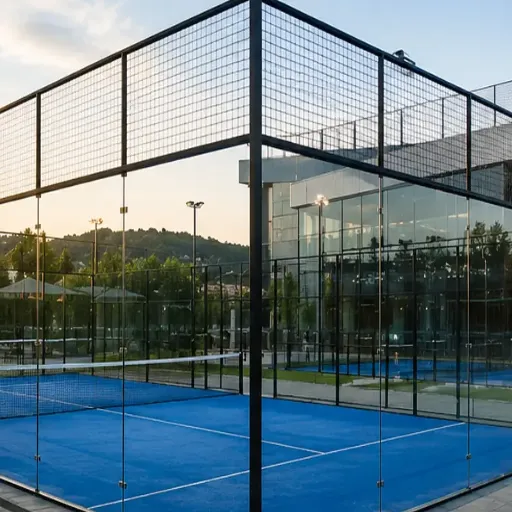
- Court type matters more than brand. A panoramic layout suits a premium club, while a roofed or classic configuration often fits everyday community facilities better.
- Scale is not the same as fit. A producer turning out hundreds of courts a year may not give a six-court project its full attention.
- Settle the requirements in writing before you sign, and ask what happens when a glass panel needs replacing in year five.
What to Check Before You Shortlist a Padel Court Manufacturer
The padel court manufacturing industry has matured quickly. A decade ago, buyers had a handful of options in Spain and very little else. Today courts are produced across Europe, Asia and the Middle East, and the gap in quality between them is wide. Most of the complaints that reach club operators after handover — rattling panels, rust bleeding through the frame, turf that flattens within two seasons — can be traced back to choices made long before the order was placed.
It helps to know which padel court specs decide whether a court survives a busy commercial schedule. The details below are worth confirming in writing rather than over the phone.
| Component | What to confirm | Common reference point |
| Playing area | Dimensions measured inside the enclosure, not the site footprint | 20 m × 10 m for standard doubles |
| Frame steel | Grade, wall thickness, and whether joints are welded or bolted | Q235B or Q355B tube steel |
| Corrosion protection | Galvanizing method and coating thickness | Hot-dip galvanizing with a zinc layer of 85 μm or more |
| Glass | Panel thickness and tempering standard | 12 mm tempered, FIP-compliant |
| Turf | Pile height, density and UV treatment | 12 mm texturized, anti-UV |
| Lighting | Illuminance at playing level and ingress protection | Around 300 lux, IP65 rated |
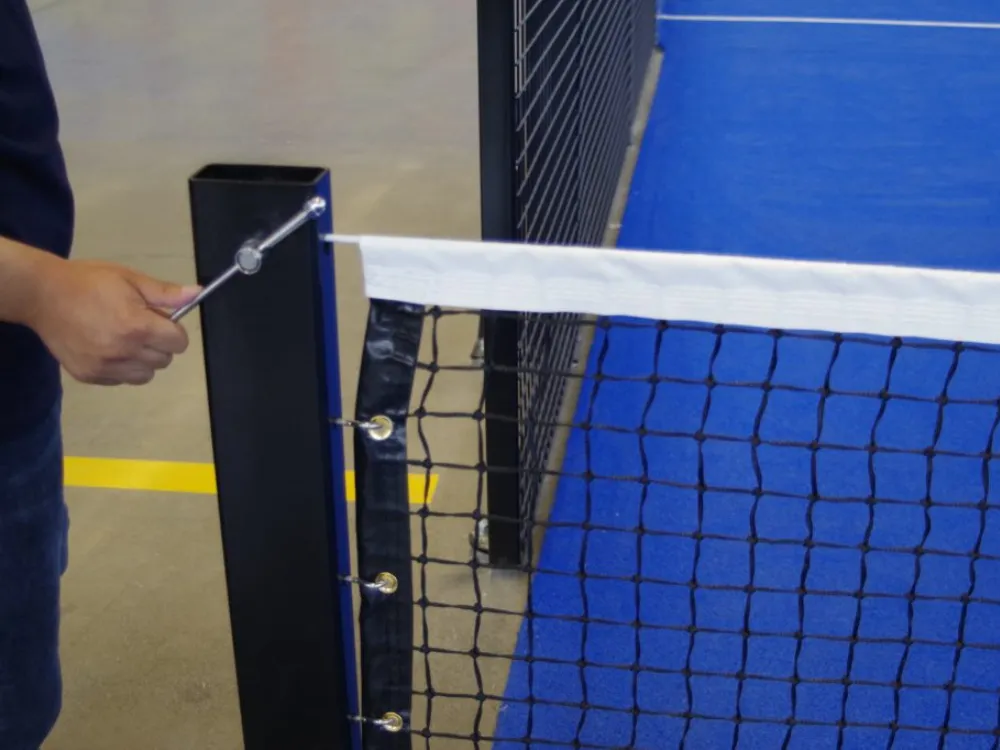
| Assembly | Whether the court bolts together on site or requires welding | Bolt-on assembly using pre-drilled holes |
| Documentation | Load ratings, test reports and warranty terms | CE / RoHS / REACH packs for the target market |
Certification and Structural Safety
A padel court is a load-bearing structure, and in most markets it is treated as a permanent installation. Certification often applies component by component, so the steel frame, the tempered glass, the lighting and the turf may each carry their own mark. Ask which parts are covered instead of assuming one certificate speaks for the whole court. Buyers shipping into the European Union also need RoHS and REACH compliance for materials, along with a named economic operator established inside the EU.
Glass, Steel and Turf: What Actually Matters
Glass is the part players notice and the part that fails loudest. Thickness and tempering quality decide how a panel behaves when someone crashes into it at speed, and edge finishing decides whether it survives the journey in a container. On the steel side, the grade and the wall thickness carry the wind loads, while the coating system determines whether the frame still looks sound after five coastal winters. Turf affects ball bounce, drainage and grip, so pile height and UV treatment should match the local climate rather than the lowest quote.
Installation, Packaging and After-Sales
Two courts that leave a factory in identical condition can perform very differently once they are standing, because installation quality varies so much. A design that bolts together from pre-drilled components removes most of that risk, particularly where the local crew has never assembled a padel court before. Packaging deserves the same scrutiny: large tempered panels travelling by sea need segmented crates, and a small number of spare panels included with the shipment can keep a project on schedule when something breaks in transit. Finally, confirm how long replacement parts stay available, and who answers the phone in year three.
10 Recommended Padel Court Manufacturers for Commercial Projects
Every company below supplies complete commercial padel court systems and has a track record beyond its home market. The numbering is for navigation only; this is not a ranking.
1. Padel Galis
Padel Galis is a Spanish manufacturer with a long association with professional padel and large international projects. It offers several court configurations aimed at clubs, sports facilities and competitive venues.
Best suited for: Large clubs, tournament venues and developers who want a partner with event experience.
2. AFP Courts
AFP Courts focuses on padel court engineering and production, and builds courts for its own range as well as for other brands. Buyers who care about structured production processes and design flexibility tend to look here.
Best suited for: Clubs and commercial facilities seeking engineered or branded court systems.
3. Portico Sport
Portico Sport supplies courts alongside sports canopies and roofing structures. That combination suits projects where the court and the cover have to be planned as a single piece of infrastructure.
Best suited for: Covered and indoor facilities, and complexes that prefer one supplier for court and canopy.
4. Pedi Sports
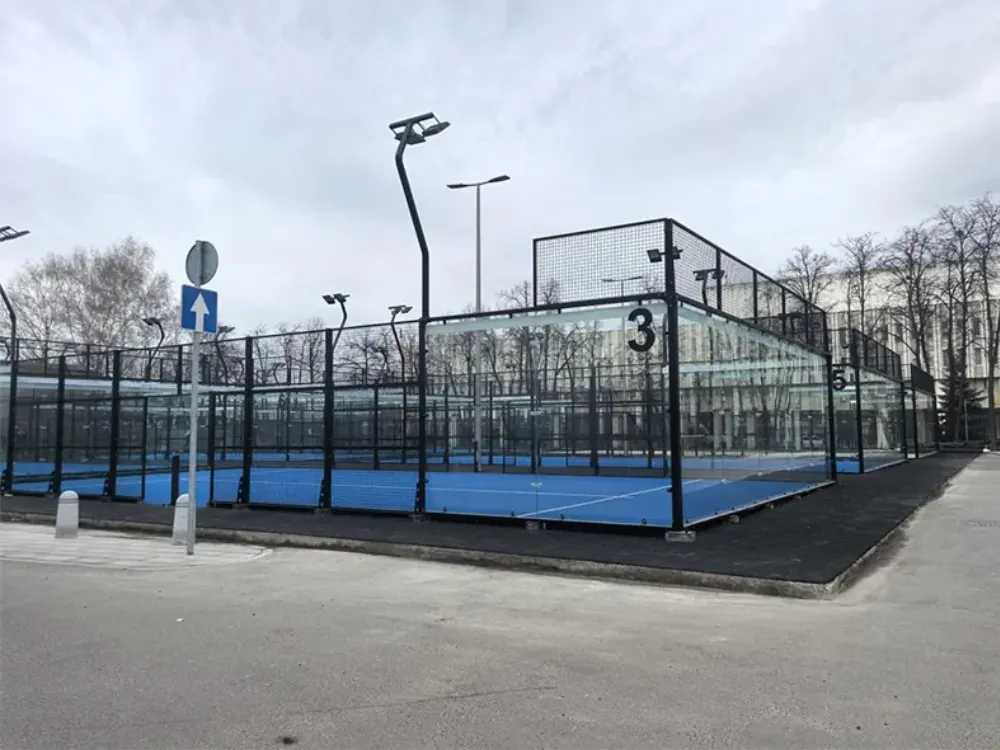
Pedi Sports Technology Co., Ltd. runs a 20,000-square-meter production base near Tianjin Port and builds its Premium Panoramic Padel Court alongside super-panoramic, classic, roofed and single court systems, as well as Padbol and squash facilities. Courts are exported to more than 15 countries, and roughly 300 complete court sets leave the factory each year.
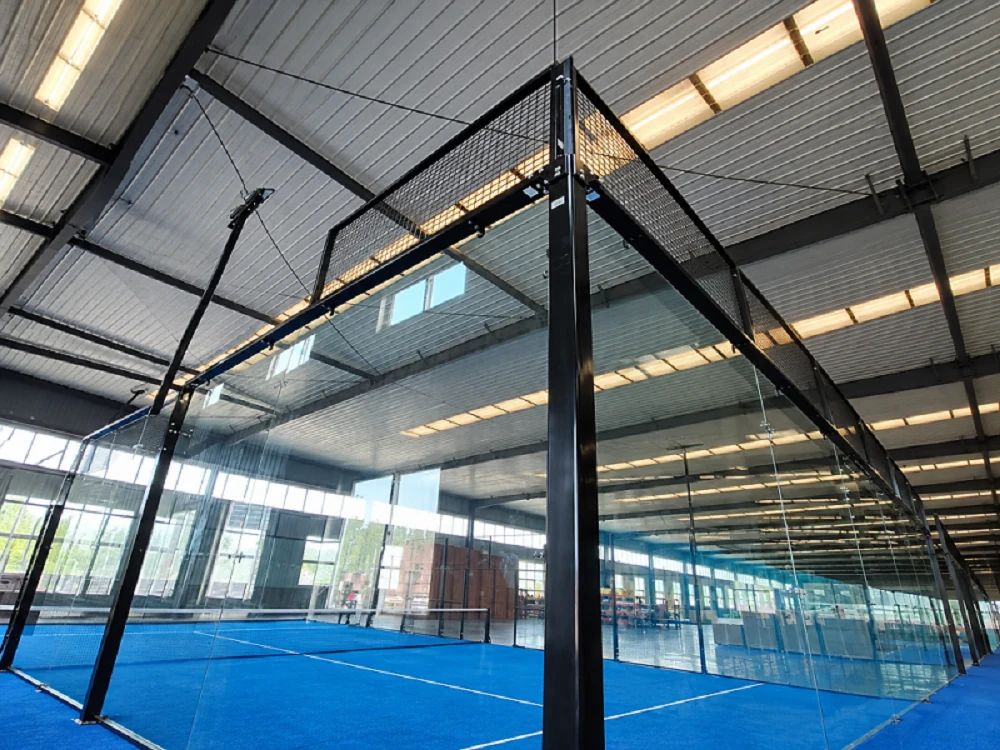
For buyers who cannot inspect a factory in person, the production process is the part worth understanding. Incoming materials are checked when they arrive, every batch passes manual inspection at each stage of production, and records are kept so that any finished court can be traced back through its build. Test reports covering the buyer’s destination market are prepared as part of the order, which saves time at the port of entry.
Support does not stop at the container. The sales team works through technical requirements, freight planning and installation coordination, and each order ships with assembly documentation and video walkthroughs for the local crew. Customization is handled with one firm rule: requests are assessed for structural safety, and a feature that cannot be built responsibly gets refused rather than quoted.
- Material checks on arrival, with records retained for every batch
- Manual inspection at each production stage rather than only at final packing
- Test reports prepared for the buyer’s destination market
- Custom requests reviewed for structural safety before they are accepted
Best suited for: Club investors, distributors and developers who want factory-direct pricing, documented quality control and support that continues after delivery.
5. MejorSet
MejorSet is a Spanish manufacturer with experience in professional tournament settings. Its range leans towards panoramic designs, and its courts are built with spectators and court presentation in mind.
Best suited for: Premium clubs and venues where player and audience experience drives the brief.
6. Padelgest
Padelgest offers several court configurations, including panoramic and super-panoramic models, alongside roofing options. Having that many variants available makes the company useful for buyers still narrowing down a design.
Best suited for: Clubs and developers comparing court layouts or planning covered courts.
7. ManzaSport
ManzaSport builds a spread of court models for club and commercial use, and supports international projects with transport and installation services.
Best suited for: Club owners comparing styles and service packages across several models.
8. Padel Tech
Padel Tech supplies several court models that differ mainly in visual design and playing environment, and its modular systems suit facilities that may expand later.
Best suited for: Buyers looking for modern designs and multiple configuration options.
9. JUBO Padel
JUBO Padel puts structural design at the center of its range, including solutions developed for locations where wind resistance matters. That focus makes the company relevant to exposed outdoor sites.
Best suited for: Outdoor facilities where wind loads and local structural rules need particular attention.
10. Padel Corporation
Padel Corporation is an Italian manufacturer offering panoramic and indoor configurations, with room for custom finishes and layouts. Its designs tend to suit projects where the court is also an architectural feature.
Best suited for: Premium clubs, hospitality developments and leisure projects with a strong design brief.
Which Manufacturer Fits Which Project
New-build commercial clubs
Multi-court developments live or die on construction speed and repeatable quality. Producers who work from pre-drilled, bolt-together components shorten the installation window and cut the risk of a local crew making mistakes on court three that they did not make on court one. Portico Sport and Padelgest are worth approaching where roofing is part of the plan, while Pedi Sports and ManzaSport tend to suit buyers who want several courts delivered on one schedule. Padel Tech modular systems also fit here, since a site that starts with two courts can expand later without redesigning the structure.
Indoor and covered facilities
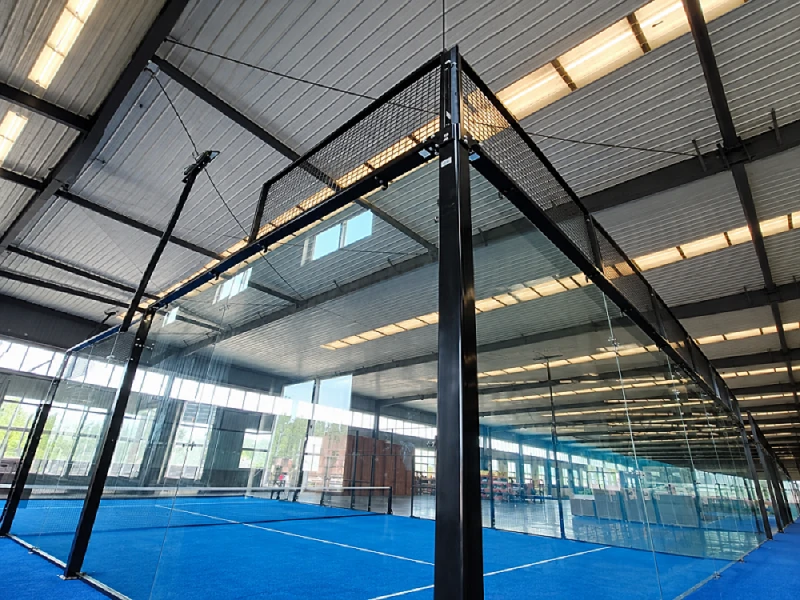
Indoor projects carry the heaviest engineering load, because the court, the structure and the ventilation all have to work together. Suppliers who already integrate canopies or indoor systems save you a coordination problem. Portico Sport leads here, with MejorSet and Padel Corporation offering strong options where the court itself is the centerpiece.
Outdoor and coastal sites
Salt air, wind and UV exposure punish outdoor courts, so the coating system and the glass fixings matter more than the finish. Buyers in coastal or storm-prone regions should press hardest on galvanizing thickness, fastener grade and wind load documentation. JUBO Padel builds specifically for demanding conditions, and Padel Galis and Pedi Sports both have experience with exposed sites.
Distributor and budget-led projects
Distributors and buyers working to a fixed budget need a manufacturer who will quote to a target, hold a delivery date and support private-label work. Factory-direct relationships matter most in this segment, since every layer between the factory and the site adds cost. Pedi Sports and AFP Courts are the natural starting points for buyers in this position.
FAQ
How much does a commercial padel court cost in 2026?
A single figure would be misleading, because the price depends on court type, glass and turf selection, whether a roof is included, freight distance and site preparation. The reliable approach is to request an itemized quote that separates the court package, shipping, installation and foundation work, then compare suppliers line by line rather than on the total.
Is the largest manufacturer of padel courts always the right choice?
No, and buyers who assume otherwise often end up frustrated. The largest manufacturer of padel courts tells you something about production volume, not about whether your project will receive attention. Large factories naturally route their best teams towards their biggest orders, which can leave a three-court or six-court buyer waiting. What actually predicts a good outcome is documented process control, technical questions answered in writing, and parts still available five years after handover.
Which details should be written into the contract?
Court dimensions measured inside the enclosure, steel grade and coating thickness, glass thickness and tempering standard, turf pile height, lighting performance, the assembly method, delivery dates, packaging, warranty terms and the spare parts policy. Anything agreed verbally tends to disappear when a project runs into trouble.
How long does manufacturing and installation take?
Many factory-direct producers quote shipping within about 20 days of order confirmation, although custom colors and roofing can extend that. On site, installation usually takes one to two weeks once the foundations are ready and the containers have cleared customs. Buyers planning an opening date should work backwards from those two windows and add buffer for freight.
What certifications should a manufacturer hold?
At minimum, look for CE marking on the steel structure, the tempered glass and any electrical components, together with RoHS and REACH compliance for materials sold into the European Union. FIP-compliant glass matters for competitive play, and some destinations require additional local marks. Ask for the documents rather than accepting a logo on a brochure.
Conclusion
Choosing a padel court manufacturer is a decision about who you will still be able to reach in five years. Certification, steel and glass quality, and assembly method decide how the court performs; documentation and after-sales support decide how quickly problems get solved when they appear. Match the supplier to the project in front of you rather than to a headline, and the rest of the build becomes considerably easier.
If you are planning a commercial padel facility and want to compare configurations, technical details and delivery options for your site, get in touch and tell us what you are building.