What Is a Single Padel Court
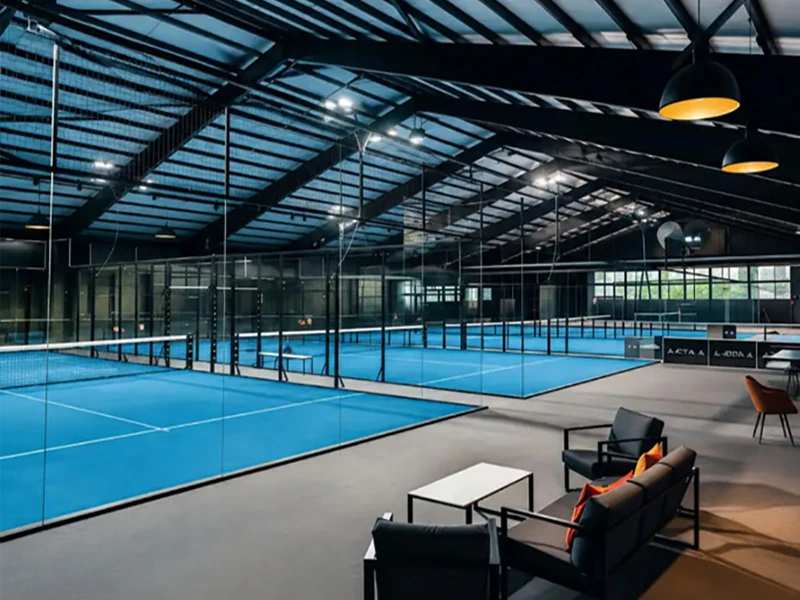
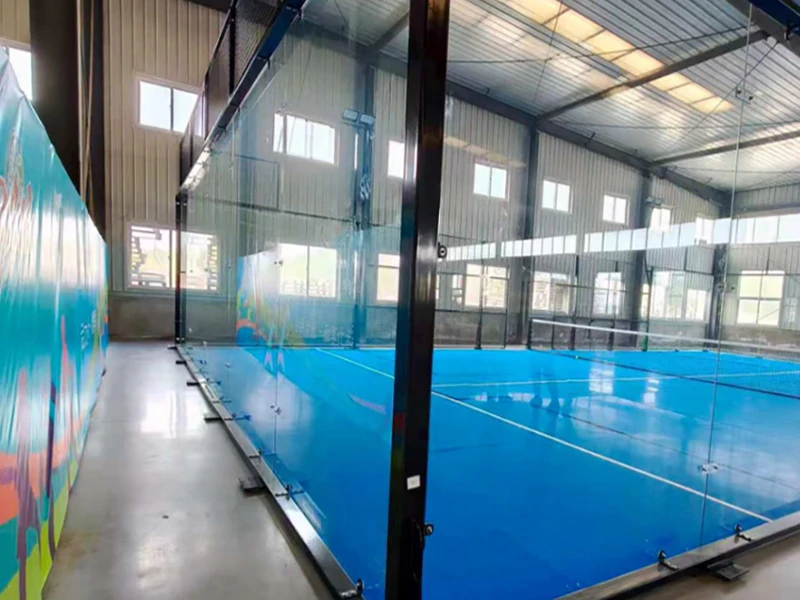
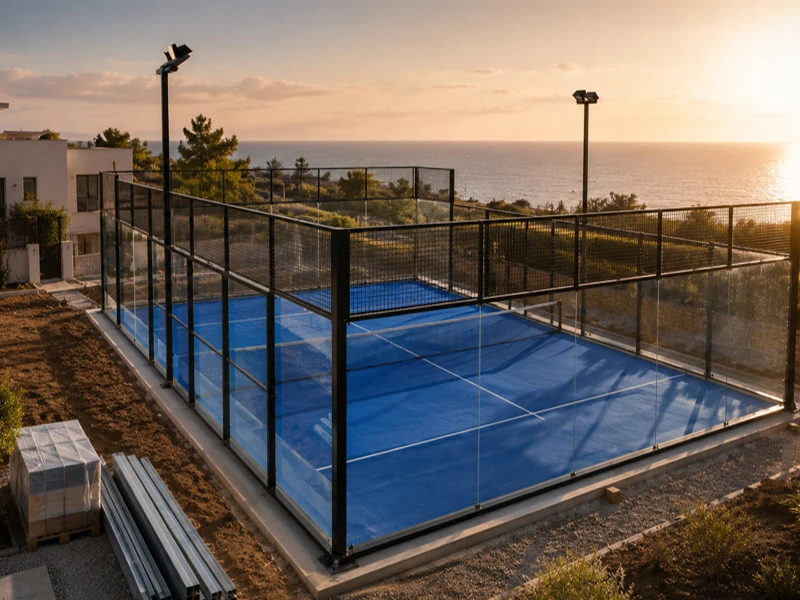
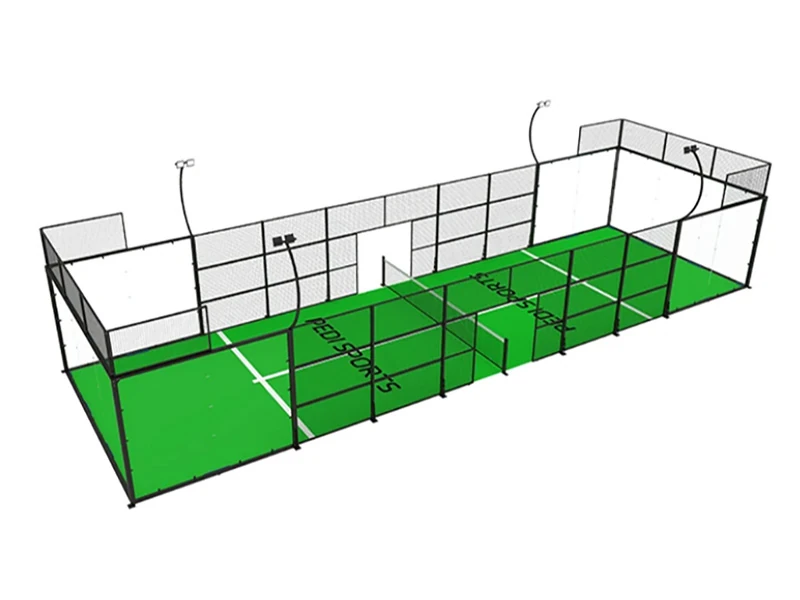
A single padel court is engineered specifically for 1-on-1 matches and targeted training sessions. The padel tennis court size of a single court is 20m × 6m, compared with 20m × 10m for a traditional doubles court. This compact configuration preserves the essence of padel: fast exchanges, angled volleys, and strategic wall play. The reduced width creates a faster-paced game that demands sharper reflexes and more precise shot placement, making it equally popular among competitive players and coaches running intensive drilling sessions. The single court works as a supplement to doubles play. This small padel court gives clubs a versatile space that adapts to different uses throughout the day.
Single Padel Court Dimensions & Space Requirements
Playing Area: 20m × 6m
The playing surface for a single padel court measures exactly 20 meters long and 6 meters wide. The net divides the court into two equal halves of 10 meters each. At the center, the net height measures 0.88 meters, rising slightly to 0.92 meters at the posts—identical to standard doubles regulations.
Glass Wall and Fence Height
The back walls of a single padel court are constructed with tempered glass panels to enable rebound play and spectator visibility, with 3 meters being the standard height across most professional installations. Side walls typically combine glass sections with welded mesh fencing, bringing the total enclosure height to 4 meters—a dimension that balances ball containment with open visibility. This combination of glass and mesh has become the industry norm, offering players consistent rebound characteristics while maintaining visual access for coaching and spectating.
Recommended Ceiling Height for Indoor Courts
For indoor installations, the minimum recommended ceiling height is 7 meters. However, professional clubs and tournament venues typically opt for 8 to 10 meters, with elite-level facilities reaching 10 to 12 meters. Higher ceilings reduce interference from lob shots and improve overall playing comfort.
Total Installation Space Required
While the playing area itself measures 20m × 6m, the total space required for installation is significantly larger to accommodate player movement, safety clearance, and spectator access:
| Configuration | Dimensions | Total Area |
| Minimum Site | 22m × 12m | 264 m² |
| Recommended Site | 24m × 14m | 336 m² |
| Comfortable Commercial Layout | 26m × 16m | 416 m² |
The additional space around the court serves multiple purposes: player runoff areas, maintenance access, entrance gates, bench seating, and spectator viewing zones. For clubs with limited land, the minimum 22m × 12m configuration remains viable, though the recommended 24m × 14m layout provides a noticeably better player and spectator experience.
What Defines a High-Quality Padel Court
Understanding what separates a premium court from a budget alternative is essential for club owners making a long-term investment.
Steel Structure
A durable court begins with a robust steel framework. Industry standards call for hot-dip galvanized steel, which undergoes a zinc coating process to prevent rust and corrosion. Premium configurations add a powder coating layer for enhanced weather resistance. Critical load-bearing components—particularly corner posts and fence columns—should utilize heavy-gauge steel with wall thicknesses of 3mm or greater to ensure structural stability under continuous play.
For installations in coastal or high-humidity regions, an electrophoretic (E-coating) treatment provides an additional protective layer, extending the steel’s operational lifespan by 3 to 5 years beyond standard galvanizing.
Tempered Glass Panels
Safety glass is a critical component of any padel court. The industry benchmark is 12mm tempered glass—thick enough to withstand repeated ball impacts and player collisions, yet transparent enough for clear visibility. High-quality courts use tempered safety glass that complies with relevant safety standards.
Artificial Turf
The quality of artificial turf affects ball behavior, player safety, and court longevity. For high-use courts, pile height is a key factor—industry standards recommend 12mm, which offers adequate shock absorption and consistent bounce without slowing the ball down too much. Turf density matters just as much; heavier traffic demands denser fibers that won’t flatten out over time. UV stabilization is equally important—without it, courts exposed to direct sunlight lose their color and structural integrity within a couple of years.
Precision Manufacturing
The quality of a padel court ultimately depends on manufacturing precision. CNC laser cutting and robotic welding produce components with high-precision structural accuracy, ensuring consistent dimensions, seamless fitting, and faster on-site assembly. Courts manufactured with loose tolerances often face installation difficulties, misaligned panels, and accelerated wear—costly problems that manifest long after the purchase is made.
How Much Does a Single Padel Court Cost
Cost Breakdown by Component
The total investment for a single padel court typically falls between $16,000 and $38,000, depending on site conditions, shipping distance, and optional upgrades.
| Cost Item | Range | Notes |
| Court Manufacturing | $6,000 – $10,000 | Complete steel, glass, turf, lighting, and net package |
| Foundation & Concrete | $5,000 – $12,000 | Varies significantly by local labor and material costs |
| Installation Labor | $3,000 – $8,000 | Depends on site accessibility and local contractor rates |
| Shipping & Logistics | $2,000 – $8,000 | Heavily influenced by destination country and port proximity |
| Estimated Total | $16,000 – $38,000 |
Step-by-Step Installation Guide
Typical Installation Process
Installing a single padel court follows a structured sequence of steps.
Site Survey – Assess ground conditions, drainage, and access points
Ground Preparation – Level and compact the installation area
Concrete Foundation Construction – Pour and level footings for steel columns
Concrete Curing – Allow 7–14 days for full strength development
Steel Frame Installation – Assemble column and beam structure
Tempered Glass Installation – Mount back and side glass panels
Mesh Fencing Installation – Secure perimeter fencing and gates
Artificial Turf Installation – Lay and secure turf surface
Silica Sand Brushing – Distribute sand infill for consistent play
LED Lighting Installation – Mount and connect the LED fixtures to light the court evenly
Net Installation – Set center net at regulation height
Final Inspection and Test Play – Verify all components
Timeline
| Phase | Duration |
| Foundation Work | 7 – 14 days |
| Court Assembly | 3 – 7 days |
| Total Project | 10 – 21 days |
4 Scenarios Where a Single Court Makes Business Sense
Urban Clubs with Limited Land
Real estate costs in city centers make full-size doubles courts difficult to justify. A single court fits into narrow plots, rooftop spaces, and indoor arenas where a doubles court simply won’t fit. This allows clubs to monetize previously unusable “dead space.”
Hotels and Resorts
Luxury properties increasingly add padel to their amenity offerings. A single court provides guests with a premium recreational activity while requiring minimal land allocation. The panoramic glass design enhances visual appeal, making the court itself an architectural feature.
Professional Training Academies
Coaches frequently use single courts for one-on-one training, intensive drilling, and match preparation. The narrower width forces players to develop sharper angles and better control, making it an effective development tool. Without the need to coordinate four players, training sessions can proceed on demand.
Private Villas and Residential Communities
Affluent homeowners and gated communities seek exclusive recreational facilities. A single padel court offers the full playing experience in a residential-friendly footprint, adding property value while providing year-round entertainment for owners and guests.
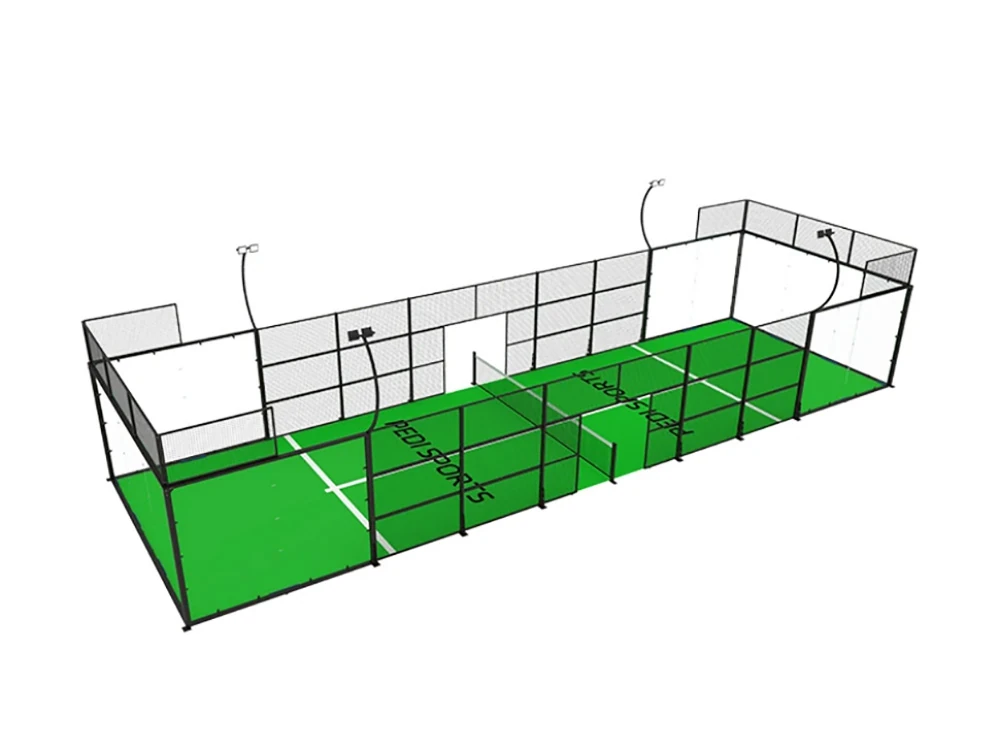
Product Spotlight: Premium Single Panoramic Padel Court (20m × 6m, 1v1)
Product Overview – What’s Included in a Complete Court Package
The Premium Single Panoramic Padel Court (Model PC004) is a purpose-built 1v1 court designed for single matches and space-limited venues. With a standardized 20m × 6m footprint, this court delivers the full padel experience in a compact configuration that fits where standard doubles courts cannot.
Each complete court package includes:
Steel structure – Heavy-duty galvanized steel frame with corner columns, fence columns, and mesh panels
Tempered glass panels – 12mm tempered safety glass for back and side walls
Artificial turf – Anti-UV, high-density turf with silica sand infill
LED lighting system – 8 × 200W IP65-rated fixtures providing 300 LUX illumination
Center net – Regulation-height net with posts
All fasteners and hardware – 304 stainless steel bolts and precision-drilled components
Installation documentation – 3D assembly manuals and remote engineering support
Technical Specifications at a Glance
| Component / Feature | Specification |
| Model | PC004 |
| Product Name | Premium Single Panoramic Padel Court |
| Court Size | 20m × 6m |
| Artificial Turf | 12mm height; 9500 Dtex; PP+PP+PU; Anti-UV |
| Tempered Glass | 1995mm × 2995mm × 12mm |
| Corner Column | 100mm × 100mm × 3mm; Hot-dip galvanized with zinc-rich powder coating |
| Fence Column | 50mm × 100mm × 3mm; Hot-dip galvanized with zinc-rich powder coating |
| Frame & Mesh | Frame: 50mm × 30mm × 3mm; Mesh: 50mm × 50mm × 4mm |
| LED Lighting | 8 pcs, 200W each; 300 LUX; IP65 rated |
| Net Height at Center | 0.88m |
| Net Height at Posts | 0.92m |
| Back Walls | 3m tempered glass |
| Total Enclosure Height | 4m (glass + fencing) |
What Sets This Court Apart
Panoramic Glass Design – Unlike standard courts with metal beam obstructions at the rear, the single panoramic court features a full-glass back wall that provides players with an immersive experience and spectators with an unobstructed view.
Zero-Weld Modular Assembly – The entire structure uses bolt-on assembly with precision-drilled countersunk holes and 304 stainless steel fasteners. Local installation teams can complete assembly without on-site welding, reducing labor costs and accelerating project timelines.
E-Coating Upgrade Option – For projects in coastal or high-humidity environments, PEDI offers an optional electrophoretic (E-coating) treatment. This advanced process delivers a smoother surface finish while providing significantly improved rust and moisture resistance, extending the court’s operational lifespan by an additional 3 to 5 years.
Spare Glass Protection – Every shipment includes 1–2 complimentary spare glass panels. This ensures that even in the event of an unforeseen accident during transit or local installation, your project timeline remains on track without costly delays.
Factory-Direct Pricing – Manufactured in PEDI’s 20,000㎡ facility using CNC laser cutting and robotic welding, the court is offered at direct-from-manufacturer prices—eliminating intermediary markups and making premium quality accessible to clubs and developers.
PEDI: The Manufacturer Behind the Court
As a trusted single padel court manufacturer, PEDI Sports has over 15 years of experience in the industry. Operating from a 20,000㎡ modern facility in Tianjin, the company holds CE, RoHS, and REACH certifications for all components. With export-grade packaging, fast global shipping, and a commitment to quality that spans more than a decade and a half, PEDI has become a trusted partner for sports clubs, resorts, and private developers worldwide.
Frequently Asked Questions
What is the size of a single padel court?
The playing area measures 20 meters in length and 6 meters in width. The net stands at 0.88 meters at the center and 0.92 meters at the posts.
How much space is needed to install a single padel court?
The minimum installation area is 22m × 12m (264 m²), though a 24m × 14m (336 m²) layout is recommended for comfortable play. Commercial venues typically opt for 26m × 16m (416 m²) to accommodate spectators and seating.
How long does installation take?
The complete process typically takes 10 to 21 days, with 7–14 days allocated for foundation curing and 3–7 days for court assembly. Weather conditions and site accessibility may affect the timeline.
Can the court be customized?
Yes. PEDI offers customized steel structure colors, turf options, and logo printing on corner pads. Free 3D layout designs are available to match your specific site dimensions.
Conclusion
A single padel court represents a practical, profitable entry point into the rapidly growing padel market. With a 20m × 6m playing area and a minimum installation footprint of just 22m × 12m, it offers clubs, resorts, hotels, and private facilities a realistic way to add padel without requiring the large land parcels needed for standard doubles courts.
From galvanized steel structures and 12mm tempered glass to UV-stabilized turf and professional LED lighting, every component matters—for player safety, playing quality, and long-term durability. Working with an experienced manufacturer ensures you receive certified materials, precision engineering, and reliable support throughout the project lifecycle.
Ready to develop your single padel court? Contact PEDI Sports today to receive factory-direct pricing and obtain a shipping quote customized for your location.