Introduction
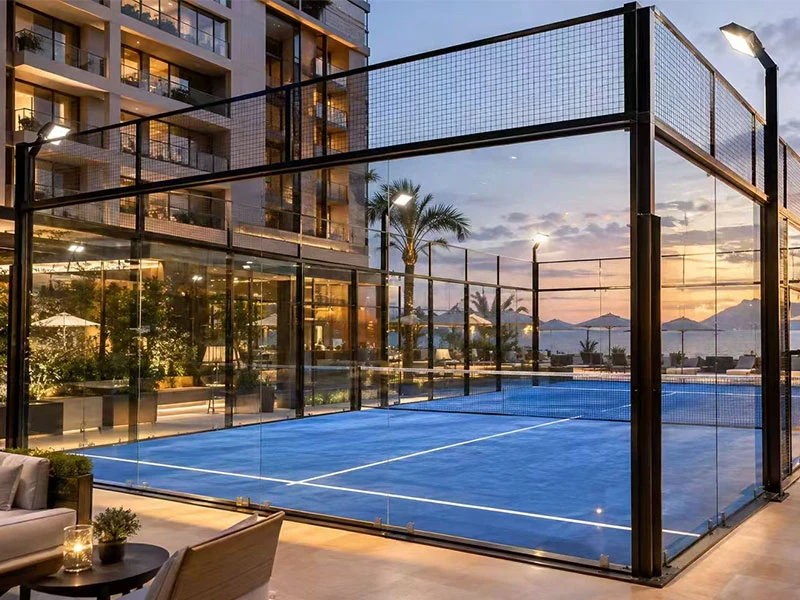
As padel becomes one of the world’s most popular sports, club owners are increasingly asking a critical question: how can they maximize court usage and protect their investment? The answer is a covered padel court.
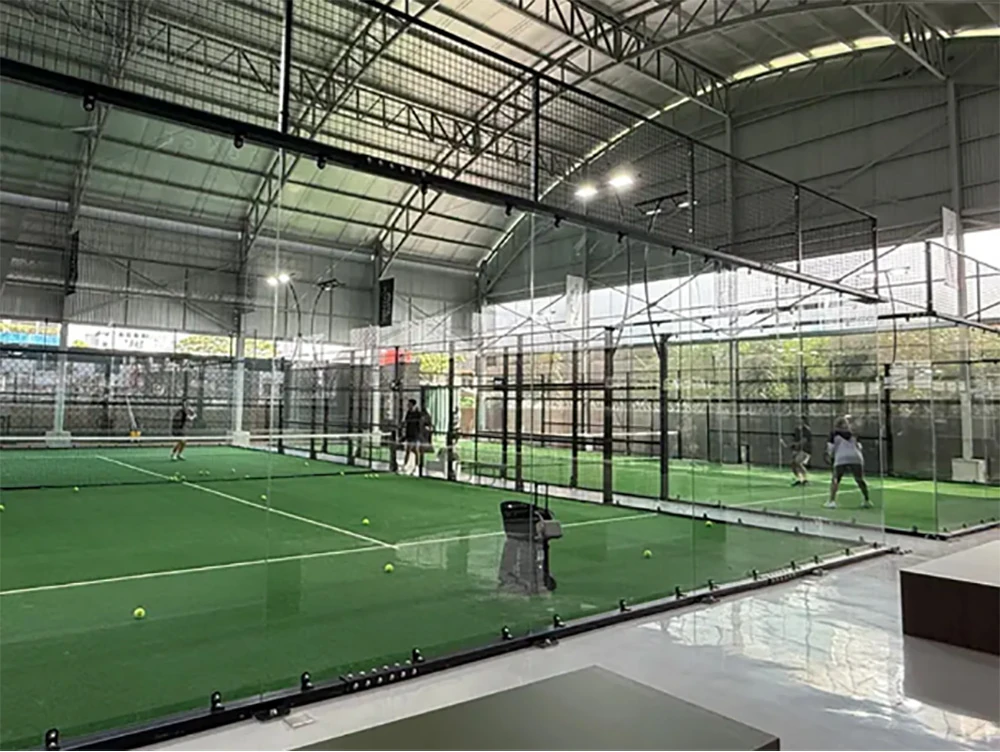
Equipped with a protective roof, the court ensures dry, safe play in rain or snow. It also blocks UV rays, wind, and direct sun, reducing player stress and health risks. Year-round availability maximizes court usage, boosting club revenue.
What Is a Padel Court with Roof?
A padel court with cover is an outdoor sports facility enhanced with a permanent covering structure.
Framework Options
Steel Structure (Hot-Dip Galvanized Q235): The use of heavy-duty Q235 steel, which is hot-dip galvanized and double-coated with a high-zinc protective layer, can effectively resist strong winds and heavy snow loads.
Aluminum Structure (High-Strength Alloy): As a lightweight alternative material, high-strength aluminum alloy boasts excellent inherent corrosion resistance and is highly suitable for humid or coastal environments. It is easy to install and usually does not require deep concrete foundations.
Covering Materials
PVC Membrane Canopy: It is made of industrial-grade polyvinyl chloride and usually has a double-sided coating to enhance durability. The PVC membrane has extremely strong waterproof properties, provides excellent UV protection, and typically meets the M2 fire safety standard to ensure public safety. Its flexibility enables it to achieve continuous laying without intermediate supports over a large span, presenting a simple and modern appearance.
Polycarbonate Canopy: Polycarbonate sheets have the characteristics of transparency or semi-transparency. They allow sunlight to enter the court during the day, significantly reducing the need for artificial lighting. Moreover, they possess excellent impact resistance, capable of withstanding hail and flying debris, and offer better insulation performance compared to single-layer fabrics.
Tensile fabric: This waterproof and UV-resistant fabric is applied over the framework. It offers significant design flexibility and a modern aesthetic, creating a sleek and minimalist appearance for sports facilities.
Why Are More Clubs Investing in Covered Padel Courts?
The global demand for covered facilities is growing rapidly. Below are the four main reasons club owners and operators are making the switch to a covered padel court—and why a padel court with roof has become the preferred choice for forward-thinking clubs.
Play All Year Round in Any Weather
Weather is the single biggest disruptor of outdoor padel. Rain, snow, strong winds, and extreme heat can cancel bookings for hours or even days at a time.
Increase Court Availability and Booking Revenue
An outdoor court without protection is usable only when the weather allows. In many regions, that translates to limited usable hours across the year, directly capping a club’s earning potential.
Improve Player Comfort and Playing Experience
Player satisfaction drives retention. A comfortable environment encourages longer sessions, more frequent visits, and positive word-of-mouth referrals.
Protect the Court and Reduce Maintenance Costs
Artificial turf, glass panels, steel frames, and lighting systems are all vulnerable to the elements. Prolonged sun exposure fades turf fibers, heavy rain promotes mold growth and base erosion, and temperature swings stress structural joints.
Outdoor Padel Court vs Covered Padel Court
Choosing between an outdoor court and a covered padel court depends on your budget, climate, and business model. The table below offers a direct comparison to help you evaluate the trade-offs.
| Feature | Outdoor Padel Court | Covered Padel Court |
| Weather Dependency | Fully dependent on weather; closed during rain, snow, or extreme heat | Less affected by most weather conditions; playable year-round |
| Court Availability | Limited to fair-weather days and seasons | High availability across all seasons |
| Initial Cost | Lower upfront investment | Higher initial construction cost |
| Player Comfort | Exposure to sun, wind, and rain | Protected from UV, rain, and temperature extremes |
| Maintenance Needs | Higher ongoing maintenance due to weather exposure | Lower long-term maintenance and surface protection |
| Booking Revenue | Capped by seasonal and daily weather limits | Higher potential revenue from increased usable hours |
| Return on Investment | Slower payback, lower lifetime revenue | Faster payback through higher utilization and rates |
Types of Roof Systems for Padel Courts
Not all roof structures are the same. The two dominant technologies in the market today are PVC membrane roofs and polycarbonate panel roofs. Understanding their differences is essential for making the right procurement decision for your padel court with roof.
PVC Membrane Roof
A PVC membrane roof uses high-strength tensile fabric—typically PVC-coated polyester—stretched over a steel or aluminum frame. This construction is lightweight, flexible, and highly durable.
Key advantages include:
- Natural light diffusion: The translucent membrane allows soft, diffused daylight to reach the court while blocking direct UV rays and rain.
- Design flexibility: The fabric can be shaped into curved, peaked, or asymmetric forms, making it suitable for custom architectural projects and rooftop padel court installations where weight limits may apply. A padel court with roof built this way can be adapted to almost any site condition.
- Wind and snow resistance: Modern tensile membranes are engineered to withstand significant wind loads and snow accumulation when properly tensioned and supported.
Polycarbonate Roof
Polycarbonate roofs use rigid, impact-resistant panels—often twin-wall or multi-wall sheets—mounted onto a fixed metal frame. This solution delivers a more solid, permanent appearance for any padel court with canopy.
Key advantages include:
- Structural rigidity: Polycarbonate panels provide a hard, stable surface that resists hail, falling debris, and high mechanical loads.
- Thermal insulation: Multi-wall polycarbonate offers superior insulation properties, reducing heat buildup underneath the roof during summer months.
- Light transmission control: Panels can be specified in clear, tinted, or diffused finishes, allowing operators to control the amount and quality of light reaching the court surface.
- Long service life: Quality polycarbonate products are UV-stabilized and typically carry warranties of 10 years or more against yellowing or brittleness.
Which Roof Option Is Right for Your Club?
The best choice depends on your priorities:
- Choose PVC membrane if you need a lightweight, cost-effective solution with design flexibility and fast installation. This is ideal for clubs seeking a padel court with canopy that offers full weather protection without the visual weight of a rigid structure.
- Choose polycarbonate if thermal insulation, maximum durability, and a solid architectural presence are your top concerns. This suits facilities in regions with extreme temperatures or clubs aiming for a premium, permanent appearance.
Premium Panoramic Padel Court with Roof from PEDI
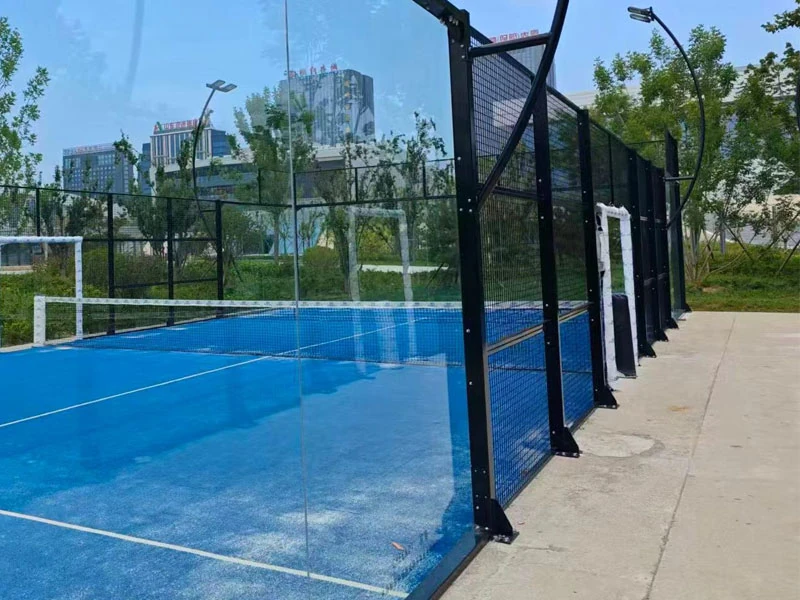
The Panoramic Padel Court with Roof from PEDI is specifically engineered for investors looking to capitalize on the sport’s momentum. This covered court ensures your venue remains open and profitable, rain or shine.
Technical Specifications
| Model | PC005 |
| Product Name | Panoramic Padel Court with Roof |
| Court Size | 20m×10m |
| Artificial Turf | Height: 12mm;Dtex: 9500;PP+PP+PU Anti-UV |
| Tempered Glass | 1995*2995*12mm |
| Roof | Top cover: PVDF |
| Color:White | |
| 100*50*3mm,80*40*2mm,50*30*2mm | |
| Column&Mesh | Hot-dip Galvanized Zinc-Rich Powder + Paint Powder |
| Corner Column | 100mm×100mm×3mm |
| Frame&Mesh | Frame:50mm×30mm×3mm Mesh:50mm×50mm×4mm |
| LED Light | 8pcs,200W LED; 300LUX;IP65 |
All-Weather PVDF Roof System
PVDF stands for polyvinylidene fluoride, which is a high-performance fluoropolymer coating that can be applied to architectural-grade polyester or PVC-coated fabrics. In the application of covered padel courts, it is a type of tensile membrane, a lightweight yet very sturdy material, covering the galvanized steel frame.
Panoramic Glass Design
Equipped with 12mm CE-certified tempered safety glass, ensuring professional-grade durability and crystal-clear visibility.
Modular Installation with No On-Site Welding
Engineered for precision, our modular system requires no welding on-site, ensuring a safer, faster, and more efficient assembly process.
Professional Playing Performance
Outfitted with high-density 12mm professional artificial turf, providing consistent ball bounce and elite-level safety for players.
Customization Options
Tailor your court to your brand identity. We offer flexible options, including custom colors for the steel frame, a variety of turf specifications, and personalized logo printing on the court structures.
Frequently Asked Questions
How much does a padel court with roof cost?
The price varies depending on your location, requirements, and custom specifications. Since PEDI is a direct-supply factory, you can avoid additional markups from middlemen. Please inform us of the project details, and we will provide a free project evaluation and quotation.
What is the difference between a PVC roof and a polycarbonate roof?
Polycarbonate is an engineering plastic, mainly composed of a polymer synthesized from bisphenol A and phosgene. PVC boards, on the other hand, are made from polyvinyl chloride. Just like the difference between glass and acrylic, their molecular structures determine completely different performance characteristics.
Can an existing outdoor padel court be upgraded with a roof?
Yes, existing outdoor padel courts can be upgraded with roof structures, but it is necessary to consider whether the original structure and size of the court meet the installation requirements.
How long does it take to install a covered padel court?
Normally, installing a standard panoramic padel court (without a roof) takes approximately 3 to 5 days. If it is a stadium with a roof, the construction period usually takes around one week.
Conclusion
In today’s rapidly growing padel market, investing in a covered padel court is a forward-thinking decision that offers strong long-term value. Although the initial investment for a covered padel court is higher than that of traditional outdoor courts, the increased usage time, higher pricing, and lower maintenance costs ensure a better return on investment. As the sport continues to mature, the clubs that truly stand out will possess consistency, comfort, and a sense of community – and a covered padel court can help deliver these qualities.