Key Takeaways
- Lighting needs rise with the level of play: roughly 200–300 lux for recreational courts, 300 lux for club play, and 500 lux or more for competitive events.
- Average brightness tells only part of the story. Uniformity and glare control decide whether players can actually see the ball.
- LED floodlights now outperform traditional lamps in energy use, lifespan, and control, making them the standard choice for new courts.
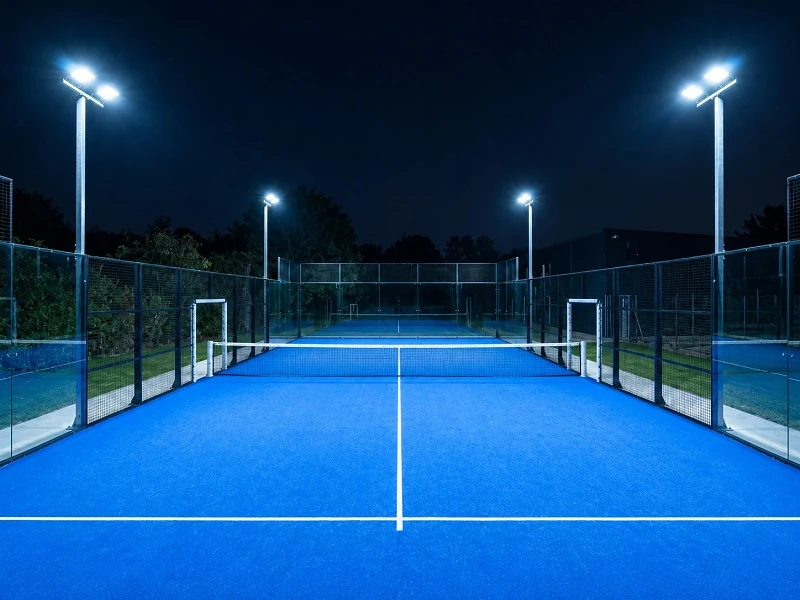
- A full-size 20×10 m court is typically fitted with eight 200 W LED floodlights on four poles, delivering around 300 lux.
- Plan lighting together with the court structure, glass panels, and electrical routing to avoid costly retrofits later.
Padel has grown from a niche sport into one of the fastest-growing racket sports in the world, and much of that growth happens after sunset. Clubs fill their courts during evening hours, resorts offer night sessions, and tournament organisers schedule matches well into the night. For all of them, padel court lighting decides how many hours a facility can operate, how comfortable players feel, and whether the venue meets the expectations of a modern sports facility.
Yet lighting is often the last thing buyers think about. Many projects start with the turf, the glass, and the steel structure, and treat light fixtures as a simple add-on. In practice, lighting is one of the most technical parts of a court build, and mistakes are expensive to correct once the court is finished. This guide explains what good padel court lighting looks like, how to choose LED fixtures with confidence, and how to plan the installation so the result is bright, even, and comfortable to play under.
Understanding Padel Court Lighting Requirements
The starting point for any lighting project is not the fixture catalogue but the level of play you intend to support. A recreational court in a hotel garden has different needs from a club that hosts regional tournaments, and both differ from a venue preparing for national finals or television coverage. Few pieces of padel court equipment affect the playing experience as much as the lighting above it.
Recreational, Club and Competitive Lighting Needs
Each level of play sets its own target for brightness and evenness. In simple terms, casual players need enough light to follow the ball comfortably, while competitive players need precise visibility for fast rallies and quick reactions. The table below shows the levels most commonly referenced by sports lighting guidelines.
| Level of Play | Typical Venue | Average Illuminance | Uniformity |
| Recreational and social play | Community centres, hotels, small clubs | 200–300 lux | 0.5 |
| Club training and regional competition | Commercial padel clubs | 300 lux | 0.5–0.7 |
| National and international competition | Tournament venues | 500 lux or more | 0.7 |
| Television broadcast | FIP-level events | Around 1,000 lux, vertical | — |
Uniformity is the ratio between the dimmest and the brightest parts of the court. A value of 0.7 means the dimmest point still receives 70 percent of the brightest point, so the whole playing surface looks even.
Illuminance, Uniformity and Glare Control
Three words appear in every lighting discussion: illuminance, uniformity, and glare. Illuminance, measured in lux, describes how much light reaches the court surface. For padel, the reference figure is usually horizontal illuminance, the light falling on the playing area itself, while broadcast events also consider vertical illuminance, the light arriving on a vertical plane around the players. Uniformity describes how evenly that light is spread. Glare is the uncomfortable brightness that hits a player’s eyes directly, usually from a fixture aimed across the line of sight.
Average lux alone is not enough to evaluate lighting quality. A court can show a respectable average reading while one corner stays noticeably darker, and players notice it immediately during a fast rally. Glare reduction matters just as much for comfortable ball tracking. Padel is played at close range, and the ball moves quickly along low trajectories, so players constantly shift their gaze across the court. A fixture that creates harsh glare makes ball tracking genuinely difficult, even when the measured brightness looks fine. Well-designed sports fixtures use internal optics to aim the light onto the court and away from players’ eyes.
Indoor vs. Outdoor Padel Court Lighting
The same lux targets apply indoors and outdoors, but the two environments raise different constraints. Indoor courts are limited by ceiling height and by the structure that carries the roof, so fixtures and mounting arms must fit within the available space. Heat build-up deserves attention too, because enclosed spaces trap the warmth that high-output lamps produce. Natural daylight deserves consideration as well: a court with windows or skylights needs a lighting layout that works with the available daylight and still performs consistently once the sun goes down.
Outdoor courts face weather, corrosion, and wind. Fixtures need a solid ingress protection rating, normally IP65 or better, so dust and rain cannot reach the electronics. Poles and mounting hardware should be hot-dip galvanized or otherwise protected against rust, and the whole installation must be assessed for wind load. Clubs near the coast, where salt air accelerates corrosion, should pay extra attention to protective coatings.
Choosing the Right LED Lights for a Padel Court
Once the lighting targets are clear, the next decision is the fixture itself. LED floodlights have become the default choice for new padel courts, for reasons that go beyond any single number.
LED Floodlights vs. Traditional Lighting
Traditional court lighting relied on metal halide and similar high-intensity lamps. They worked, but they consumed a great deal of power, took time to reach full brightness, and faded noticeably as they aged. LEDs changed this picture in almost every way. Modern LED floodlights use roughly half the energy of older lamps to deliver the same light, and last 50,000 hours or more instead of a few thousand. They also reach full output instantly, and allow dimming and switching that saves even more energy when courts sit empty.
Instant-on performance matters more than it may seem. With traditional lamps, a club often keeps the lights burning all evening because restarting takes time; with LEDs, courts can be lit on demand and switched off the moment a session ends. Over a year of operation, that behaviour alone reduces electricity bills noticeably. Maintenance costs fall in the same direction: LED fixtures keep working for their full rated life, so lamp changes become rare events instead of an annual ritual, and fewer replacements mean lower labour and parts bills over the life of the court.
Key Parameters to Compare
When comparing fixtures, a handful of parameters carry most of the weight. The table below explains what each one means and what a sensible target looks like.
| Parameter | What It Means | What to Look For |
| Luminous efficacy | How much light each watt produces | 130 lm/W or higher |
| Correlated colour temperature (CCT) | The perceived warmth or coolness of the light | 4,000–5,000 K, a natural white |
| Colour rendering index (CRI) | How accurately colours appear under the light | 80 or higher; 90+ for broadcast |
| Beam angle | How wide the light spreads | Medium-to-narrow optics for sports use |
| Ingress protection (IP) | Resistance to dust and water | IP65 or higher for outdoor courts |
| Rated lifespan | How long the fixture keeps working | 50,000 hours or more |
| Dimming and control | Whether lights can be switched or dimmed on a schedule | DALI or simple scheduling controls |
CRI is easy to overlook but surprisingly visible on court. A low-CRI light makes the yellow ball and the white lines look dull, and colours across the venue appear washed out. A rating of 80 handles most club play, while venues planning television coverage should aim for 90 or above. Durability deserves the same attention as brightness: outdoor fixtures should withstand impacts from balls and equipment, resist corrosion in humid or coastal air, and carry a warranty long enough to match their rated lifespan.
How Many LED Lights Does a Padel Court Need?
The most common answer for a standard 20×10 m court is eight LED floodlights, mounted two per pole on four poles. With 200 W fixtures, this configuration typically delivers around 300 lux, which comfortably covers club-level play.
That said, the correct number always depends on the target illuminance, the beam angle of the chosen fixture, the mounting height, and the specific layout of the court. A higher mounting height spreads light differently from a lower one, and a narrow-beam fixture behaves differently from a wide-beam model. For this reason, professional projects rely on a photometric simulation rather than a rule of thumb. The simulation models how each beam lands on the playing surface and shows whether the court will meet its lux and uniformity targets before a single pole is installed.
A Complete Lighting Package in Practice
To see how these decisions come together, it helps to look at a widely used reference configuration. Many club projects worldwide specify a full-size panoramic court with eight 200 W LED floodlights on four poles, reaching roughly 300 lux across the playing area, a level that suits club training, regional competition, and most commercial venues.
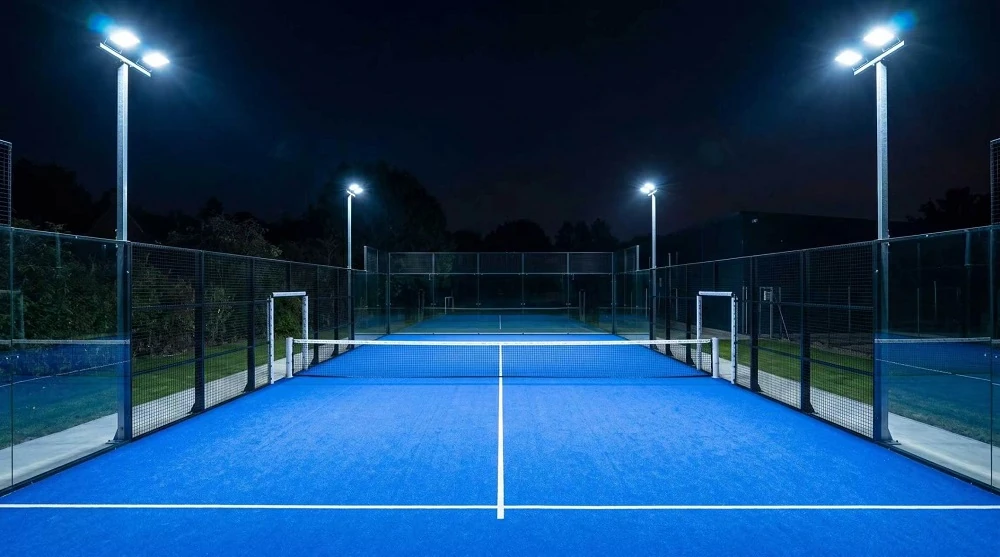
A common example of this approach is the Premium Panoramic Padel Court (PC001) from PEDI Sports. The standard package includes eight 200 W LED floodlights rated IP65, delivering around 300 lux, with fixtures certified to the European Low Voltage Directive 2014/35/EU and tested to EN IEC 60598-1 and EN IEC 60598-2-1. The 110–240 V operating range means the same package adapts to different markets without special wiring.
What makes this approach practical is that the lighting is designed as part of the court rather than bolted on afterwards. The same project scope covers the 12 mm tempered glass, the hot-dip galvanized steel frame, the anti-UV artificial turf, and the lighting layout, so electrical routing, pole placement, and structural coordination are handled together from the start. For a buyer managing a project in another country, that single-source approach removes much of the coordination burden.
Padel Court Lighting Design and Layout
Good fixtures in the wrong positions still produce a disappointing court. Layout is where the design work happens, and it should be settled early, because moving poles and cabling after installation is expensive.
Lighting Pole Placement and Mounting Height
The standard layout places four poles around the court, with two fixtures on each pole, positioned so the beams overlap evenly across the playing surface. Mounting height is one of the most influential decisions. Most guidelines recommend a minimum of 6 metres, and 6 to 8 metres is common for club installations. Higher mounting reduces glare and spreads light more evenly, while lower mounting concentrates brightness but increases the chance that players look directly into the fixtures.
Pole positions must also respect the court itself. Poles normally stand outside the playing enclosure, clear of the fencing and the glass, so they neither block movement nor interfere with play. Their exact position should be coordinated with the court’s structural design, because the same installation often shares foundations, cable routes, and access paths with the court structure.
Avoiding Shadows and Glare on Glass Panels
Panoramic courts use large glass panels at the back and sides, and glass reflects light in ways that metal mesh does not. If a fixture faces a glass panel directly, players may see a bright reflection exactly where they need to track the ball. The fix comes from aiming, beam angle, and position: fixtures should direct light onto the court surface rather than across the glass, and should sit outside the natural sightlines of the players. Shadows belong in the same conversation: a pole, bracket, or overhanging structure close to the glass can cast a moving shadow across the playing area, so the layout should keep both glare and shadow away from the court.
Surface colours play a role here as well. The padel court colours you choose influence how light behaves during play: darker fencing reduces distracting reflections, while a mid-tone turf keeps the playing area visually calm under bright floodlights. A light, glossy surface can amplify reflections, so colour choices deserve the same attention as the fixtures themselves.
Integrating Lighting into Padel Court Design
Lighting performs best when it is treated as part of the padel court design rather than an afterthought. A court designed with lighting in mind coordinates the poles with the fencing and glass panels, plans the electrical routes before the ground is finished, and leaves room for maintenance access around each fixture. It also anticipates upgrades: choosing fixtures and control systems that support future changes keeps the court flexible as the club grows.
Padel Court Lighting Installation: Step-by-Step Guide
When lighting the padel court, most projects follow a similar sequence from assessment to final testing. Working through these steps in order keeps the installation safe, compliant, and unlikely to need rework.
Step 1 — Assess the Site and Lighting Requirements
Start by confirming whether the court will be indoor or outdoor, the exact court dimensions, and the lighting levels the venue needs to support. Check local electrical codes and any sports lighting standards that apply in the region, because requirements vary from country to country. This assessment becomes the reference for every later decision.
Step 2 — Plan the Electrical and Structural Layout
With the targets set, plan where the poles, cabling, and power supply will go, and confirm that the structure can support the installation. Outdoor courts need a wind-load check for poles and brackets, while indoor courts need clearance between fixtures and the roof structure. Good drainage near pole bases also keeps water away from electrical connections. The checklist below captures the essentials:
- Pole positions and mounting heights match the lighting layout
- Cable routes and power supply sized for the total load
- Earth leakage and circuit protection for each pole
- Wind-load and structural capacity confirmed for outdoor poles
- Access for maintenance around every fixture
Step 3 — Install and Align the Lighting Fixtures
Follow the manufacturer’s installation instructions, and have the electrical work carried out by qualified electricians. Fixture alignment deserves care at this stage: the aiming angles set now determine the final uniformity and glare, so align each fixture to the photometric plan rather than by eye alone.
Step 4 — Test and Commission the Lighting System
Once everything is installed, measure the actual illuminance across the playing area and compare it with the design targets. Check uniformity, look for glare and reflections from the glass, and confirm that the controls and safety devices work correctly. Small adjustments to aiming angles at this stage are normal, and they are far cheaper than discovering a problem after the court opens.
Common Padel Court Lighting Mistakes to Avoid
Most lighting problems on padel courts come from a handful of recurring decisions. Avoiding these mistakes saves money and rework:
- Choosing fixtures by wattage alone, without checking beam angle and optical design
- Chasing an average lux figure while ignoring uniformity and glare
- Positioning lights without considering reflections from glass panels
- Using indoor fixtures outdoors, where moisture and corrosion shorten their life
- Forgetting wind-load and structural checks for outdoor poles, and failing to plan for fixture maintenance and replacement
- Skipping on-site measurements after installation, so problems surface only at night
FAQ
How many lux does a padel court need?
Recreational courts typically need 200–300 lux, club-level play around 300 lux, and competitive events 500 lux or more. Venues planning television coverage usually aim for around 1,000 lux of vertical illuminance.
How many LED lights does a padel court need?
A standard 20×10 m court is usually fitted with eight LED floodlights, mounted two per pole on four poles. The exact number depends on the target lux, beam angle, and mounting height, so a photometric simulation is the reliable way to confirm the count.
What height should padel court light poles be?
Most guidelines recommend a minimum mounting height of 6 metres, with 6 to 8 metres common for club installations. Higher poles spread light more evenly and reduce glare.
What IP rating should outdoor padel court lights have?
Outdoor fixtures should be rated IP65 or higher to resist dust and rain. Coastal sites benefit from corrosion-resistant housings and galvanized mounting hardware as well.
Can regular floodlights be used for a padel court?
Standard garden floodlights are not a good fit. Sports fixtures use optical designs that control glare and spread light evenly across the court, which ordinary floodlights generally lack.
Conclusion
Padel court lighting is a small part of the overall budget, yet it shapes the experience of every player who steps onto the court after sunset. Start with the level of play you want to support, choose LED fixtures with the right optics and protection, and plan the layout together with the court structure. Courts that follow this path look bright, feel comfortable, and keep their operators out of expensive rework.
If you are planning a new padel court or upgrading an existing one, contact PEDI Sports for a lighting package designed around your court and your market.